

Reading's Armoured Heart sculpture unveiled ahead of Knife Crime Awareness Week
Updated: Jun 23, 2023
“The reason for the increase of knife crime is fear. There is now an increase in fear within our communities.”
These words were delivered by youth worker Moses Heidenbluth at the launch of Reading’s new Armoured Heart sculpture on Monday, May 15.
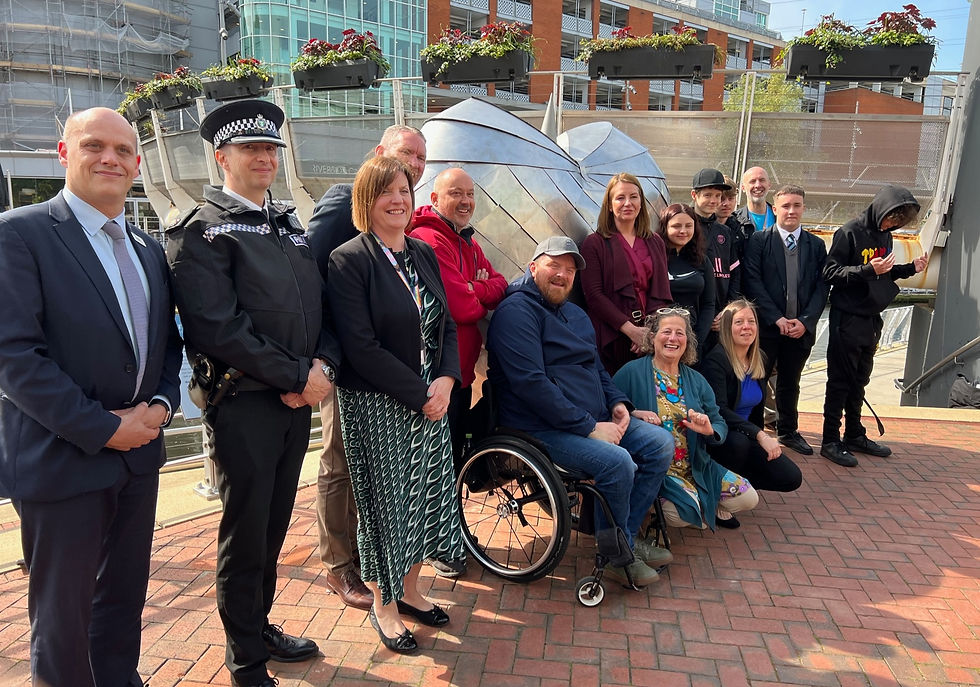
Stakeholders gathered outside The Oracle shopping centre to catch a glimpse of the artwork, made partially from melted down weapons handed into amnesty bins across the town.
The 2-metre-tall sculpture, created by local artist Stuart Melrose, will look to inspire young people to make positive choices about knives and symbolises the town’s commitment to tackling knife crime.
Thought-provoking speeches were delivered by Cllr Karen Rowland, the Council’s lead member for environmental services and community safety, Mr Melrose and activist Moses Heidenbluth, on what was the first day of Knife Crime Awareness Week.
The Amnesty Art Project
The installation was created by Mr Melrose, alongside members of Starting Point mentoring service’s Young Voices project.
Speaking after the ceremony, he said: “To get it installed and finished on time is amazing. To be honest, the idea I came in with was nothing like what the sculpture looks like now.
“[The young people] have progressed the ideas, shown us what they wanted and taken it to what it is now. It wouldn’t have been here without the kids.”
The structure is made up of multiple precision-cut stainless steel diamonds to depict armour plating, with a swirling steel finial shape at the top made from recovered weapons.
“I found it amazingly educational to work with the people who have been involved in knife crime, and harrowing as well,” he added. “You meet some characters that are just so strong and powerful after going through what they’ve done.”
Passersby are encouraged to visit the monument and learn more about its significance through its adjacent noticeboard by the riverside.
A digital layer is also accessible via mobile phones through augmented reality technology.
The project received £64,000 in sponsorship to fund the sculpture and the development of associated educational resources. The breakdown was as follows:
GWR Community Fund 2022/23 | £44,000 |
|---|---|
British Airways | £7,500 |
Thames Valley Violence Reduction Unit | £12,000 |
Individual donations from community sponsors | £500 |
One the rise: Knife crime in numbers
Knife crime is one the up, both nationally and regionally.
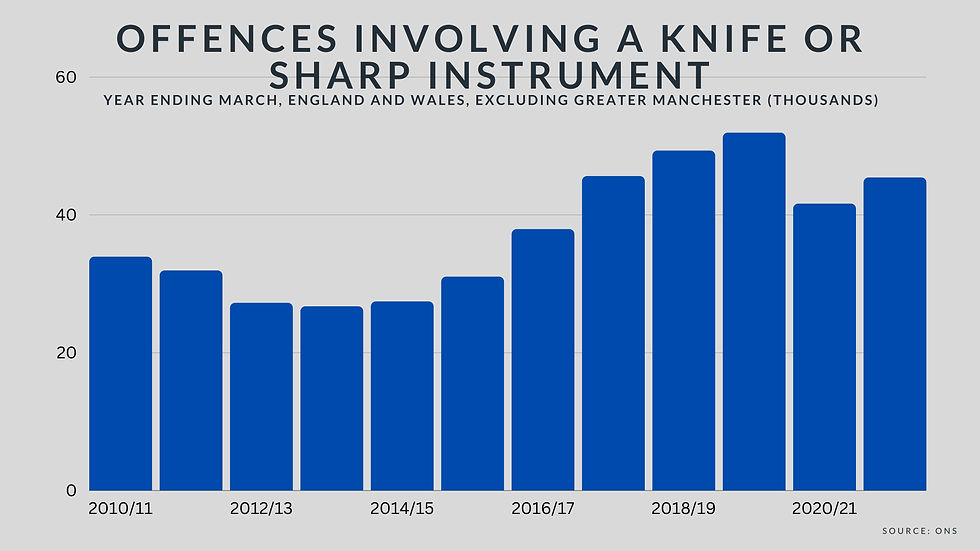
Police-recorded data published by the ONS showed the number of offences involving knives has increased every year since 2013/14, the only exception being in 2020/21 when Covid-19 lockdowns were enforced.
Although knife crime only made up 2% of all recorded incidents in Reading in 2020/21, the number of recorded knife crimes increased that year.
Click the elements below to learn about the key figures:
45,400 offences involving a sharp instrument in England and Wales
ONS data showed there was a 9.1% increase in knife-related offences in England and Wales (not including Greater Manchester) in 2021/22. This latest figure is more than a third higher than in 2010/11.
50 offences per 100,000 in Thames Valley
The same parliamentary research briefing revealed there were 50 knife offences per 100,000 people in the Thames Valley in 2021/22, six lower than the average for the South East (56).
1st: Reading experiences most serious violence in Berkshire
In 2021, Reading saw the highest levels of serious violence in Berkshire, and the second highest in the Thames Valley.
841 arrests for crimes involving knives
Thames Valley Police revealed in their most recent end of year report that 841 people had been arrested for knife crimes, a 2% rise from the previous year (823).
Town rallies after death of schoolboy Olly Stephens
Reading was left heartbroken in January 2021, when 13-year-old Olly Stephens was fatally stabbed in a field near his house in Emmer Green.
His parents, Stuart and Amanda, attended the sculpture’s unveiling.
Of the occasion, Mrs Stephens said: “It’s really positive. It’s the culmination of a lot of hard work from a lot of people. To get to this point, to actually have it on a sunny day - now it’s here forever.
"It just feels like a point in time, it feels like history’s being made. Things will move forward now.
“It’s about making sure we’re all thinking about it because we can all make a positive difference when we do talk about it with our children.”
She commended the efforts set to be made during the week by the police and The Ben Kinsella Trust to ensure anti-knife crime information packs were sent out to schools across the country.
The Stephens’ believe social media companies have an important role to play in protecting young people but aren’t doing enough to prevent exposure to violent and harmful content.
Mr Stephens explained: “We paid for it. We just didn’t understand and assumed [children] were protected online. We assumed there was a duty of care - there isn’t.
“The bottom line is those companies are there to make money, and they will make money any way they can.
“It is child exploitation, however they want to dress it up, they are exploiting children for profit. That needs to change.”
‘People who carry knives are more likely to be victims of knife crime’
Superintendent Steve Raffield represented Thames Valley Police at the unveiling ceremony, an event he described as 'a really positive sign’.
The force’s Violence Reduction Unit is tasked with decreasing the number of serious violence cases in the area, the majority of which are knife-enabled.
Last year, TVP carried out 10,000 patrols at the 67 hotspots it has identified using police, local authority, third party and hospital admissions data.
Its strategy in combatting knife crime involves targeting individuals known to carry knives, as well as engaging with young people - often through schools liaison officers.
Speaking to Reading Today, TVP chief constable Jason Hogg said: “We have a list of known individuals who carry knives and we target those proactively, using whatever powers we have available.
“The sad reality is that the people who carry knives are more likely to be victims of knife crime, so carrying a knife does not make people safe, quite the reverse.
“The message we want to get across is: people shouldn’t carry knives in the first place.”
Do you believe enough is being done to combat knife crime in your area?
Yes
No
Reading Borough Council's Community Safety and Serious Violence Strategy 2023 to 2026, features reducing knife violence as one of its seven priorities.
The report stated: “Our partnership has already taken steps to prepare for this new duty following a number of devastating knife related deaths in Reading over the last two years.
“The partnership is committed to tackling knife crime and ensuring the prevention of further loss of life and serious injury.”
The council has installed knife amnesty bins in key locations across the town to encourage people to surrender bladed articles.
During Knife Crime Awareness Week, also known as Operation Sceptre, police and partners will look to increase awareness of the risks and consequences of carrying knives.
The other side: Escaping a life of crime
Mr Heidenbluth, an educator and founder of Giveback FC - a football team which gives young men a positive space to be, delivered a powerful testimony at the ceremony detailing his first hand-experiences with knife crime.
He described mixing with "the wrong type of people" and entering the criminal world at just 13-years-of-age, a decision which ultimately led to him serving prison time.
Following his release, Mr Heidenbluth has gone on to work with vulnerable young people through school talks and Giveback.
Speaking to Reading Today, he said: “It’s been quite an emotional day, there are families here who have lost family and friends to knife crime. But it’s good to unite as one and move Reading forward for the better.
“Knife crime is much bigger than people think. It’s not just people from gangs, council estates, London, but it has crept into smaller towns like Reading, and it’s involving people who would never have carried a knife, weapon or been involved with that kind of life.
“But because of fear, people, especially young people, are worried about what’s going on, so they’ve decided to take [knives] as an option.
“We need to show them that that’s not an option because you’re only increasing this culture of carrying a knife.”
You can call ChildLine on 0800 1111 at any time if you are worried about your own safety or think that someone you know is carrying or even using a knife.
If you have information about knife crime in your area and you are nervous about going to the police, you can call the independent charity Crimestoppers 100% anonymously on 0800 555 111 or visit their website. They will never ask for your name or try to trace the number that you are calling from.



Comments